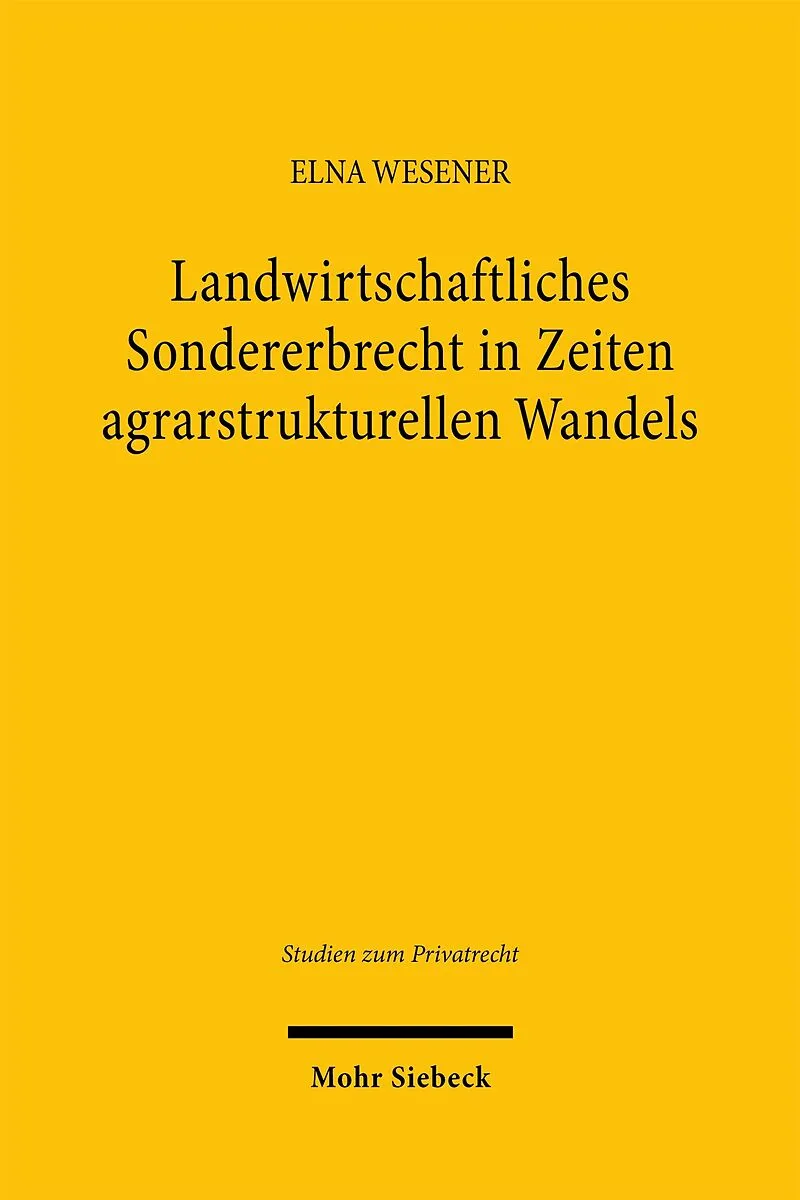
Landwirtschaftliches Sondererbrecht in Zeiten agrarstrukturellen Wandels
Einband:
Kartonierter Einband
EAN:
9783162002143
Genre:
Zivilprozessrecht
Autor:
Elna Wesener
Herausgeber:
Mohr Siebeck GmbH & Co. K
The special inheritance law for agricultural holdings shows a considerable need for reform, as it no longer adequately reflects the conditions of modern agricultural enterprises. Nevertheless, there remains a need for specific inheritance regulations, which Elna Wesener develops within a comprehensive and constitutionally compliant reorganization.
The fragmented body of law governing the special rules of agricultural inheritance is characterized by a pronounced resistance to reform. Whereas the special inheritance regulations for agricultural holdings once pursued the aim of preventing farms from being broken up into smaller, economically unviable parcels and of "ensuring the nourishment of the population," these objectives can no longer be fully justified in light of profound structural changes in agriculture. The focus has now shifted to preserving a multifunctional agricultural sector, characterized by the fact that, alongside traditional food production, it increasingly fulfills regional, social, ecological, cultural, and societal functions. Moreover, the current legal framework is unable to adequately reflect the modern realities of agricultural enterprises. For example, the management of an agricultural operation has become increasingly complex, family structures have become more diverse, and more active estate planning is now common. In view of the dramatic upheavals occurring in agriculture, however, there remains a heightened need for a specially designed framework of inheritance law. The newly developed regulatory proposal aims to create a fair balance of interests between the heirs who do not take over the farm and those entitled to compulsory portions on the one hand, and the successor to the agricultural holding on the other. Its objective is to mitigate, at least in the area of inheritance law, the challenges faced by family-run agricultural enterprises.
Autorentext
Born 1998; studied law at the University of Münster; PhD in 2025; legal clerkship at the Higher Regional Court of Celle.
Inhalt
Einleitung
A. Historische Entwicklung des landwirtschaftlichen Sondererbrechts
I. Die Anfänge des Anerbenrechts
II. Die Einflüsse der Bauernbefreiung auf das Anerbenrecht
III. Gesetzgeberische Aktivitäten seit Mitte des 19. Jahrhunderts
IV. Entstehung des BGB-Landguterbrechts
V. Bestrebungen einer reichsgesetzlichen Anerbengesetzgebung in der Weimarer Republik
VI. Agrarpolitische Gesetzgebung im Nationalsozialismus
VII. Anerbenrecht in der Nachkriegszeit
B. Die durch den agrarstrukturellen Wandel veränderten Realitäten der Landwirtschaft und deren Auswirkungen auf die Zielsetzungen des landwirtschaftlichen Sondererbrechts
I. Zielsetzungen des landwirtschaftlichen Sondererbrechts
II. Veränderte Realitäten in der Landwirtschaft als Anlass zur Neuformulierung der Zielsetzungen des landwirtschaftlichen Sondererbrechts?
III. Fazit
C. Heute geltende Rechtslage
I. Bundeseinheitliche Regelungen
II. Partielles Bundesrecht: Nordwestdeutsche Höfeordnung (HöfeO)
III. Landesanerbengesetze
IV. Fazit
D. Verfassungsrechtliche Rechtfertigung des landwirtschaftlichen Sondererbrechts
I. Vereinbarkeit mit der Eigentums- und Erbrechtsgarantie gemäß Art. 14 Abs. 1 S. 1 GG
II. Vereinbarkeit mit Art. 3 Abs. 1 GG
III. Fazit
E. Rechtspolitische Diskussion
I. Vorschläge aus der Literatur
II. Stellungnahme und eigener Reformvorschlag
III. Fazit
Schlussbetrachtung und Ausblick
Leider konnten wir für diesen Artikel keine Preise ermitteln ...
billigbuch.ch sucht jetzt für Sie die besten Angebote ...
Die aktuellen Verkaufspreise von 6 Onlineshops werden in Realtime abgefragt.
Sie können das gewünschte Produkt anschliessend direkt beim Anbieter Ihrer Wahl bestellen.
Loading...
Die aktuellen Verkaufspreise von 6 Onlineshops werden in Realtime abgefragt.
Sie können das gewünschte Produkt anschliessend direkt beim Anbieter Ihrer Wahl bestellen.
| # | Onlineshop | Preis CHF | Versand CHF | Total CHF | ||
|---|---|---|---|---|---|---|
| 1 | Seller | 0.00 | 0.00 | 0.00 |