The Destiny of Man
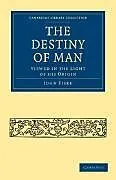
Einband:
Kartonierter Einband (Kt)
EAN:
9781108005135
Genre:
Novels & Stories
Autor:
John Fiske
Herausgeber:
Cambridge University Press
Erscheinungsdatum:
22.07.2009
Klappentext In 1884! American historian and Darwin populariser John Fiske published this book on human progress via evolutionary change. Zusammenfassung American historian John Fiske published in 1884 this discussion of humanity's origin! destiny and place in the universe. A leading populariser of Darwin's theory in the United States! Fiske discusses his views of human progress via evolutionary social change and the harmony between science and religion. Inhaltsverzeichnis Preface; 1. Man's place in nature as affected by the Copernican theory; 2. As affected by Darwinism; 3. On the earth there will never be a higher creature than man; 4. The origin of infancy; 5. The dawning of consciousness; 6. Lengthening of infancy and concomitant increase of brain-surface; 7. Change in the direction of the working of natural selection; 8. Growing predominance of the psychical life; 9. The origins of society and of morality; 10. Improvableness of man; 11. Universal warfare of primeval men; 12. First checked by the beginnings of industrial civilisation; 13. Methods of political development! and elimination of warfare; 14. End of the working of natural selection upon man; 15. The message of Christianity; 16. The question as to a future life.
Autorentext
John Fiske was an American philosopher and historian. He was highly influenced by Herbert Spencer and incorporated Spencer's evolutionary principles into his own studies on languages, philosophy, religion, and history. John Fiske was born Edmund Fiske Green on March 30, 1842, in Hartford, Connecticut. He was the sole child of Edmund Brewster Green of Smyrna, Delaware, and Mary Fiske Bound of Middletown, Connecticut. His father edited newspapers in Hartford, New York City, and Panama before dying in 1852. His widow married Edwin W. Stoughton of New York in 1855. Edmund Fiske Green took the name of his maternal great-grandfather, John Fiske, when his mother married for the second time. From 1869 to 1871, he was a philosophy professor at Harvard, then a history instructor in 1870, and finally an assistant librarian from 1872 to 1879. After quitting from the latter job in 1879, he was elected to the board of overseers and was re-elected when his six-year term expired in 1885. Beginning in 1881, he spoke on American history at Washington University in St. Louis on an annual basis, and he became a professor of American history there in 1884, but he continued to live in Cambridge, Massachusetts.
Klappentext
In 1884, American historian and philosopher John Fiske published The Destiny of Man, which discussed humanity's origin, destiny and place in the universe. A leading populariser of Darwin's theory in the United States and influenced by Herbert Spencer, Fiske considers views of human progress via evolutionary social change and the harmony between science and religion. The Destiny of Man is composed of sixteen chapters that anticipate philosophical questions from a typical non-scientific audience: the origins of atheism, the shifting hierarchal positions of humanity through history as proposed by Copernicus and later by Darwin, human brain size, and the 'dawning of consciousness' as a result of the growth and development of moral sentiment and inventiveness through natural selection. Interestingly, at the end of the book, Fiske discusses the historical power relationships of ruling governments and predicts that as humans evolve and become more civilised, war will eventually end.
Zusammenfassung
American historian John Fiske published in 1884 this discussion of humanity's origin, destiny and place in the universe. A leading populariser of Darwin's theory in the United States, Fiske discusses his views of human progress via evolutionary social change and the harmony between science and religion.
Inhalt
Preface; 1. Man's place in nature as affected by the Copernican theory; 2. As affected by Darwinism; 3. On the earth there will never be a higher creature than man; 4. The origin of infancy; 5. The dawning of consciousness; 6. Lengthening of infancy and concomitant increase of brain-surface; 7. Change in the direction of the working of natural selection; 8. Growing predominance of the psychical life; 9. The origins of society and of morality; 10. Improvableness of man; 11. Universal warfare of primeval men; 12. First checked by the beginnings of industrial civilisation; 13. Methods of political development, and elimination of warfare; 14. End of the working of natural selection upon man; 15. The message of Christianity; 16. The question as to a future life.
Leider konnten wir für diesen Artikel keine Preise ermitteln ...
billigbuch.ch sucht jetzt für Sie die besten Angebote ...
Die aktuellen Verkaufspreise von 6 Onlineshops werden in Realtime abgefragt.
Sie können das gewünschte Produkt anschliessend direkt beim Anbieter Ihrer Wahl bestellen.
Loading...
Die aktuellen Verkaufspreise von 6 Onlineshops werden in Realtime abgefragt.
Sie können das gewünschte Produkt anschliessend direkt beim Anbieter Ihrer Wahl bestellen.
| # | Onlineshop | Preis CHF | Versand CHF | Total CHF | ||
|---|---|---|---|---|---|---|
| 1 | Seller | 0.00 | 0.00 | 0.00 |