Collective Electrodynamics
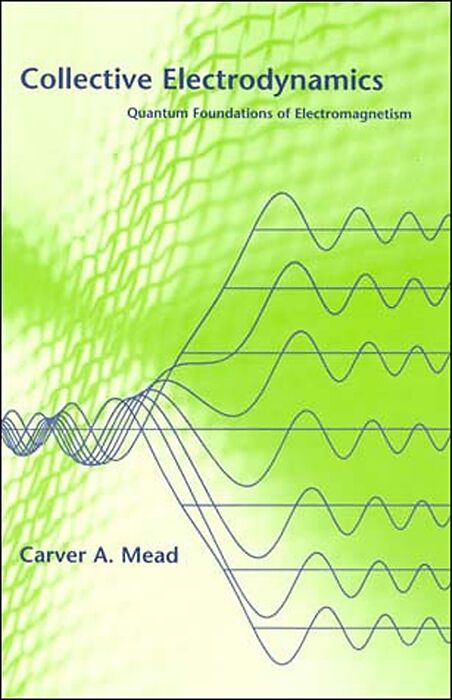
Einband:
Kartonierter Einband
EAN:
9780262632607
Autor:
Carver A. Mead
Herausgeber:
MIT Press
Erscheinungsdatum:
26.07.2002
Informationen zum Autor Carver A. Mead is the Gordon and Betty Moore Professor of Engineering and Applied Science, Emeritus, at the California Institute of Technology. He won the 1999 Lemelson-MIT Prize for Invention and Innovation. Klappentext In this book Carver Mead offers a radically new approach to the standard problems of electromagnetic theory. Motivated by the belief that the goal of scientific research should be the simplification and unification of knowledge, he describes a new way of doing electrodynamicscollective electrodynamicsthat does not rely on Maxwell's equations, but rather uses the quantum nature of matter as its sole basis. Collective electrodynamics is a way of looking at how electrons interact, based on experiments that tell us about the electrons directly. (As Mead points out, Maxwell had no access to these experiments.) The results Mead derives for standard electromagnetic problems are identical to those found in any text. Collective electrodynamics reveals, however, that quantities that we usually think of as being very different are, in fact, the samethat electromagnetic phenomena are simple and direct manifestations of quantum phenomena. Mead views his approach as a first step toward reformulating quantum concepts in a clear and comprehensible manner. The book is divided into five sections: magnetic interaction of steady currents, propagating waves, electromagnetic energy, radiation in free space, and electromagnetic interaction of atoms. In an engaging preface, Mead tells how his approach to electromagnetic theory was inspired by his interaction with Richard Feynman. Zusammenfassung In this book Carver Mead offers a radically new approach to the standard problems of electromagnetic theory. Motivated by the belief that the goal of scientific research should be the simplification and unification of knowledge, he describes a new way of doing electrodynamicscollective electrodynamicsthat does not rely on Maxwell's equations, but rather uses the quantum nature of matter as its sole basis. Collective electrodynamics is a way of looking at how electrons interact, based on experiments that tell us about the electrons directly. (As Mead points out, Maxwell had no access to these experiments.) The results Mead derives for standard electromagnetic problems are identical to those found in any text. Collective electrodynamics reveals, however, that quantities that we usually think of as being very different are, in fact, the samethat electromagnetic phenomena are simple and direct manifestations of quantum phenomena. Mead views his approach as a first step toward reformulating quantum concepts in a clear and comprehensible manner. The book is divided into five sections: magnetic interaction of steady currents, propagating waves, electromagnetic energy, radiation in free space, and electromagnetic interaction of atoms. In an engaging preface, Mead tells how his approach to electromagnetic theory was inspired by his interaction with Richard Feynman....
Autorentext
Carver A. Mead is the Gordon and Betty Moore Professor of Engineering and Applied Science, Emeritus, at the California Institute of Technology. He won the 1999 Lemelson-MIT Prize for Invention and Innovation.
Klappentext
In this book Carver Mead offers a radically new approach to the standard problems of electromagnetic theory. Motivated by the belief that the goal of scientific research should be the simplification and unification of knowledge, he describes a new way of doing electrodynamics—collective electrodynamics—that does not rely on Maxwell's equations, but rather uses the quantum nature of matter as its sole basis. Collective electrodynamics is a way of looking at how electrons interact, based on experiments that tell us about the electrons directly. (As Mead points out, Maxwell had no access to these experiments.) The results Mead derives for standard electromagnetic problems are identical to those found in any text. Collective electrodynamics reveals, however, that quantities that we usually think of as being very different are, in fact, the same—that electromagnetic phenomena are simple and direct manifestations of quantum phenomena. Mead views his approach as a first step toward reformulating quantum concepts in a clear and comprehensible manner. The book is divided into five sections: magnetic interaction of steady currents, propagating waves, electromagnetic energy, radiation in free space, and electromagnetic interaction of atoms. In an engaging preface, Mead tells how his approach to electromagnetic theory was inspired by his interaction with Richard Feynman.

Leider konnten wir für diesen Artikel keine Preise ermitteln ...
billigbuch.ch sucht jetzt für Sie die besten Angebote ...
Die aktuellen Verkaufspreise von 6 Onlineshops werden in Realtime abgefragt.
Sie können das gewünschte Produkt anschliessend direkt beim Anbieter Ihrer Wahl bestellen.
Loading...
Die aktuellen Verkaufspreise von 6 Onlineshops werden in Realtime abgefragt.
Sie können das gewünschte Produkt anschliessend direkt beim Anbieter Ihrer Wahl bestellen.
| # | Onlineshop | Preis CHF | Versand CHF | Total CHF | ||
|---|---|---|---|---|---|---|
| 1 | Seller | 0.00 | 0.00 | 0.00 |