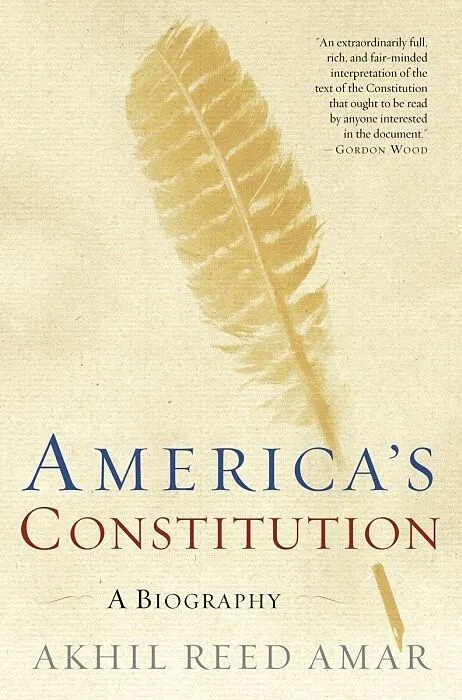
America's Constitution
Einband:
Kartonierter Einband
EAN:
9780812972726
Genre:
Political Science
Autor:
Akhil Reed Amar
Herausgeber:
Random House Children's Books
Erscheinungsdatum:
12.09.2006
Informationen zum Autor Akhil Reed Amar graduated from Yale College and Yale Law School, and has been a member of the Yale Law School faculty since 1985. He is the author of The Bill of Rights: Creation and Reconstruction and has written widely on constitutional issues for The New York Times , The Washington Post , and Los Angeles Times . He lives in Woodbridge, Connecticut, with his wife and three children. Klappentext This authoritative [and] important ( The New York Times Book Review ) biography of America's framing document explores topics ranging from presidential power and freedom of speech to birthright citizenship and beyond, explaining not only what the Constitution says but also why the Constitution says it. Elegantly written, thorough but concise, and consistently enlightening . . . an indispensable reference.Scott Turow, The Washington Post Book World (Best Books of the Year) WINNER OF THE AMERICAN BAR ASSOCIATION'S SILVER GAVEL AWARD In America's Constitution , eminent constitutional-law scholar Akhil Reed Amar gives the first comprehensive account of one of the world's great political texts. Skillfully placing the document in the context of late-eighteenth-century American politics, Amar reveals how a document that was in large part drafted by slaveholding landed gentry could later be instrumental in the emancipation of slaves, the enfranchisement of women, and many other modern expansions of liberty and equality. Amar celebrates the Constitution's remarkable durability, noting how debate over its central role in American government remains vital and dynamic more than two centuries after it was written. Ambitious, evenhanded, accessible, and often surprising, America's Constitution is an invaluable work, bound to become a standard reference for any student of history and all citizens of the United States. Leseprobe Chapter 1 In the Beginning The Pennsylvania Packet, and Daily Advertiser (September 19, 1787). When, after a summer of closed meetings in Philadelphia, America's leading statesmen went public with their proposed Constitution on September 17, 1787, newspapers rushed to print the proposal in its entirety. In several printings, the dramatic words of the Preamble appeared in particularly large type. It started with a bang. Ordinary citizens would govern themselves across a continent and over the centuries, under rules that the populace would ratify and could revise. By uniting previously independent states into a vast and indivisible nation, New World republicans would keep Old World monarchs at a distance and thus make democracy work on a scale never before dreamed possible. We . . . do With simple words placed in the document's most prominent location, the Preamble laid the foundation for all that followed. We the People of the United States, . . . do ordain and establish this Constitution . . . These words did more than promise popular self-government. They also embodied and enacted it. Like the phrases I do in an exchange of wedding vows and I accept in a contract, the Preamble's words actually performed the very thing they described. Thus the Founders' Constitution was not merely a text but a deeda constituting. We the People do ordain. In the late 1780s, this was the most democratic deed the world had ever seen. Behind this act of ordainment and establishment stood countless ordinary American voters who gave their consent to the Constitution via specially elected ratifying conventions held in the thirteen states beginning in late 1787. Until these ratifications took place, the Constitution's words were a mere proposalthe text of a contract yet to be accepted, the script of a wedding still to be performed. The proposal itself had emerged from a special conclave held in Philadelphia dur...
Autorentext
Akhil Reed Amar graduated from Yale College and Yale Law School, and has been a member of the Yale Law School faculty since 1985. He is the author of The Bill of Rights: Creation and Reconstruction and has written widely on constitutional issues for The New York Times, The Washington Post, and Los Angeles Times. He lives in Woodbridge, Connecticut, with his wife and three children.
Klappentext
This “authoritative [and] important” (The New York Times Book Review) “biography” of America’s framing document explores topics ranging from presidential power and freedom of speech to birthright citizenship and beyond, explaining not only what the Constitution says but also why the Constitution says it.
“Elegantly written, thorough but concise, and consistently enlightening . . . an indispensable reference.”—Scott Turow, The Washington Post Book World (Best Books of the Year)
WINNER OF THE AMERICAN BAR ASSOCIATION’S SILVER GAVEL AWARD
In America’s Constitution, eminent constitutional-law scholar Akhil Reed Amar gives the first comprehensive account of one of the world’s great political texts. Skillfully placing the document in the context of late-eighteenth-century American politics, Amar reveals how a document that was in large part drafted by slaveholding landed gentry could later be instrumental in the emancipation of slaves, the enfranchisement of women, and many other modern expansions of liberty and equality. Amar celebrates the Constitution’s remarkable durability, noting how debate over its central role in American government remains vital and dynamic more than two centuries after it was written.
Ambitious, evenhanded, accessible, and often surprising, America’s Constitution is an invaluable work, bound to become a standard reference for any student of history and all citizens of the United States.
Leseprobe
Chapter 1 In the Beginning The Pennsylvania Packet, and Daily Advertiser (September 19, 1787). When, after a summer of closed meetings in Philadelphia, America’s leading statesmen went public with their proposed Constitution on September 17, 1787, newspapers rushed to print the proposal in its entirety. In several printings, the dramatic words of the Preamble appeared in particularly large type. It started with a bang. Ordinary citizens would govern themselves across a continent and over the centuries, under rules that the populace would ratify and could revise. By uniting previously independent states into a vast and indivisible nation, New World republicans would keep Old World monarchs at a distance and thus make democracy work on a scale never before dreamed possible. “We . . . do” With simple words placed in the document’s most prominent location, the Preamble laid the foundation for all that followed. “We the People of the United States, . . . do ordain and establish this Constitution . . .” These words did more than promise popular self-government. They also embodied and enacted it. Like the phrases “I do” in an exchange of wedding vows and “I accept” in a contract, the Preamble’s words actually performed the very thing they described. Thus the Founders’ “Constitution” was not merely a text but a deed—a constituting. We the People do ordain. In the late 1780s, this was the most democratic deed the world had ever seen. Behind this act of ordainment and establishment stood countless ordinary American voters who gave their consent to the Constitution via specially elected ratifying conventions held in the thirteen states beginning in late 1787. Until these ratifications took place, the Constitution’s words were a mere proposal—the text of a contract yet to be accepted, the script of a wedding still to be performed. The proposal itself had emerged from a special conclave held in Philadelphia during the summer of 1787. Twelve state governments—all except Rhode Isl…
Leider konnten wir für diesen Artikel keine Preise ermitteln ...
billigbuch.ch sucht jetzt für Sie die besten Angebote ...
Die aktuellen Verkaufspreise von 6 Onlineshops werden in Realtime abgefragt.
Sie können das gewünschte Produkt anschliessend direkt beim Anbieter Ihrer Wahl bestellen.
Loading...
Die aktuellen Verkaufspreise von 6 Onlineshops werden in Realtime abgefragt.
Sie können das gewünschte Produkt anschliessend direkt beim Anbieter Ihrer Wahl bestellen.
| # | Onlineshop | Preis CHF | Versand CHF | Total CHF | ||
|---|---|---|---|---|---|---|
| 1 | Seller | 0.00 | 0.00 | 0.00 |